
Inverter vs Non-Inverter Aircon: What’s the Difference and Which Is Better in Singapore?

If you are buying a new air conditioner in Singapore, one of the biggest decisions you will face is choosing between an inverter aircon and a non-inverter aircon.
Many homeowners ask:
What is an inverter aircon?
Is inverter aircon worth it in Singapore?
Does inverter aircon really save electricity?
Which is better for HDB flats?
Is non-inverter aircon cheaper to maintain?
Understanding the difference between inverter and non-inverter air conditioners can help you save money, reduce electricity bills, and choose the right cooling system for your home.
In this guide, we explain how inverter and non-inverter aircons work, compare their pros and cons, and help Singapore homeowners decide which option is best for their lifestyle and budget.
What Is an Inverter Aircon?
An inverter aircon uses variable-speed compressor technology to regulate cooling efficiently. Instead of constantly turning the compressor on and off, the inverter compressor adjusts its speed depending on the room temperature.
This allows the aircon to:
Maintain stable temperatures
Use less electricity
Reduce sudden power consumption
Cool rooms more efficiently
Once the desired temperature is reached, the inverter system slows down rather than shutting off completely. This is why inverter air conditioners are known for better energy efficiency and quieter operation.
What Is a Non-Inverter Aircon?
A non-inverter aircon uses a traditional fixed-speed compressor.
The compressor operates in a simple ON/OFF cycle:
Turns on at full power when cooling is needed
Turns off once the target temperature is reached
Turns on again when the room becomes warm
Because the compressor repeatedly starts and stops, non-inverter systems usually consume more electricity over time. However, non-inverter air conditioners are often cheaper upfront.

Which Aircon Saves More Electricity?
Inverter air conditioners are significantly more energy efficient.
This is especially important in Singapore because aircons are used frequently due to hot and humid weather.
Why Inverter Aircon Saves Electricity
When a non-inverter compressor repeatedly starts from zero, it consumes a large amount of power.
An inverter compressor avoids this by running continuously at lower speeds after reaching the desired temperature.
This leads to:
Lower monthly electricity bills
Reduced energy wastage
Better long-term savings
Is Inverter Aircon Better for Singapore Homes?
For most Singapore households, yes.
Singapore’s climate makes inverter air conditioners the preferred choice because:
Aircons run daily
Bedrooms often use overnight cooling
Humidity levels remain high year-round
Inverter systems are particularly useful for:
HDB flats
Condominiums
Families with daily aircon usage
Homeowners concerned about electricity costs
Advantages of Inverter Aircon
1. Lower Electricity Bills
One of the biggest benefits is energy savings. Although inverter aircons cost more initially, many homeowners save money over time through reduced utility bills.
2. Quieter Operation
Because the compressor does not repeatedly start and stop loudly, inverter aircons usually operate more quietly.
This is ideal for:
Bedrooms
Baby rooms
Home offices
3. Faster Cooling
Inverter compressors can initially operate at higher speeds to cool rooms quickly.
Once the room cools down, the compressor slows to maintain comfort efficiently.
4. More Stable Temperature
Inverter systems maintain a more consistent room temperature without noticeable fluctuations. This improves comfort during sleep and long usage periods.
5. Longer Compressor Lifespan
Frequent ON/OFF cycles place stress on compressors. Because inverter systems avoid constant restarting, they often experience less wear and tear.
Disadvantages of Inverter Aircon
1. Higher Upfront Cost
Inverter aircons are more expensive to purchase and install. However, many homeowners recover the cost through long-term electricity savings.
2. More Complex Repairs
Inverter systems contain advanced electronics and circuit boards. Repairs can sometimes cost more compared to simpler non-inverter systems.
Advantages of Non-Inverter Aircon
1. Lower Purchase Price
Non-inverter air conditioners are usually cheaper upfront.
This may suit:
Rental units
Temporary housing
Low-usage households
2. Simpler Technology
Non-inverter systems use simpler compressor technology, which can sometimes make repairs easier and cheaper.
Disadvantages of Non-Inverter Aircon
1. Higher Electricity Consumption
The biggest downside is higher energy usage. Frequent compressor restarting consumes more electricity, especially in Singapore’s climate.
2. Noisier Operation
The repeated compressor startup cycles create more noticeable noise.
3. Less Comfortable Cooling
Temperature fluctuations are more noticeable compared to inverter systems.
Is Inverter Aircon Worth the Extra Cost?
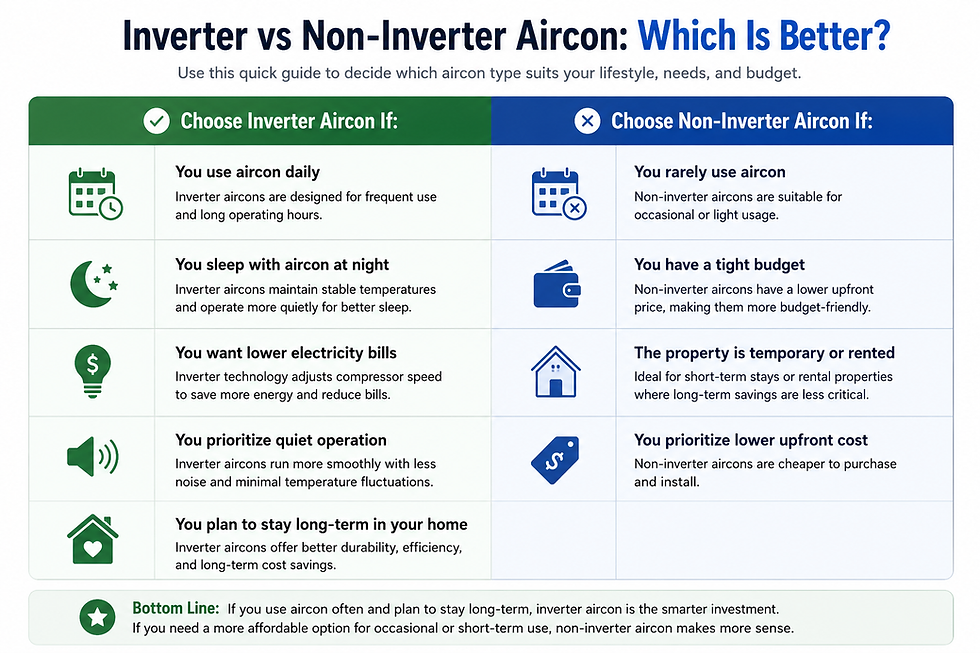
For most Singapore homeowners, inverter aircon is worth the investment. Although the initial cost is higher, the long-term electricity savings can be substantial. In households where aircon runs daily, inverter systems usually provide better value over time.

How Aircon Servicing Affects Performance
Whether you choose inverter or non-inverter aircon, regular servicing is essential in Singapore.
Without maintenance:
Cooling performance drops
Electricity bills increase
Water leaks become common
Mold and dust build up
Regular aircon servicing helps:
Improve cooling efficiency
Extend compressor lifespan
Reduce electricity consumption
Prevent costly breakdowns
Experts generally recommend servicing every 3 to 4 months for Singapore homes.
Final Verdict: Inverter vs Non-Inverter Aircon
For most homeowners in Singapore, inverter air conditioners are the better long-term choice.
They offer:
Better energy efficiency
Lower electricity bills
Quieter operation
Faster cooling
Improved comfort
Non-inverter aircons may still suit budget-conscious users or homes with occasional
aircon usage, but inverter systems usually deliver better value over time in Singapore’s climate.
If you are investing in a new aircon system for your HDB flat, condo, or landed property, inverter aircon is generally the recommended option for long-term comfort and savings.
At Shiok Aircon, we help Singapore homeowners maintain both inverter and non-inverter air conditioners with honest pricing, professional servicing, and reliable workmanship tailored for Singapore’s humid weather.
Whether you need general servicing, chemical wash, troubleshooting, or maintenance contracts, proper servicing keeps your aircon cold, efficient, and long-lasting year-round.
Frequently Asked Questions
1) Does inverter aircon really save electricity?
Yes. Inverter aircons reduce electricity usage by adjusting compressor speed instead of constantly restarting.
2) Is inverter aircon better for sleeping?
Yes. Inverter systems are quieter and maintain more stable temperatures overnight.
3) Why is inverter aircon more expensive?
Inverter systems use advanced compressor and electronic control technology.
4) Is non-inverter aircon outdated?
Not necessarily. Non-inverter systems still suit light users and budget-focused buyers.
5) Which aircon type is best for Singapore?
For most homes in Singapore, inverter aircon is the preferred choice because of better energy efficiency and daily usage patterns.


Comments